For years, the cleanest way to think about cloud AI was as an abstraction. Pick a model, call an API, watch the quality and cost curves, and let somebody else worry about the machines. That abstraction still works at the application boundary. It is becoming less reliable as a planning assumption.
The constraint is moving down the stack. Electricity supply, grid connections, transformers, cooling systems, battery capacity, permits, and local acceptance now shape how quickly new AI capacity can come online. The International Energy Agency describes a scramble across electricity, grid connections, manufacturing capacity, chips, and capital—not simply a shortage of accelerators.
For engineering and technology leaders, this is not an invitation to become energy traders. It is a reason to treat AI capacity as a physical dependency, with the same care given to data residency, network reach, or a critical supplier.
Key takeaway
The model is only one layer of the AI platform. Durable strategy now depends on the power, cooling, equipment, and regional capacity underneath it.
The abstraction is breaking
A model endpoint makes intelligence look locationless. The infrastructure behind it is anything but. A cloud region needs generation capacity, substations, transmission, transformers, backup power, cooling, water or alternative heat-rejection systems, and permission to expand. Those assets operate on timelines measured in years, while AI product roadmaps often operate in quarters.
The mismatch matters because not every announced data-centre project will be built, and not every region can add power at the same pace. A vendor may have access to a leading model yet be unable to guarantee the volume, geography, or expansion schedule an enterprise assumes. Capacity risk can therefore surface as quotas, delayed region availability, price changes, or requests to accept a different accelerator or model.
The IEA’s October policy review surveyed 34 jurisdictions representing 90% of global data-centre capacity. Its focus—affordability, sustainability, and energy security— is a useful signal: data-centre integration has moved from a facilities detail to a system-level concern.
Demand is rising faster than the supporting system
The IEA projects global data-centre electricity consumption to roughly double, from 485 terawatt-hours (TWh) in 2025 to 950 TWh in 2030. That would equal about 3% of global electricity demand. Within that total, electricity use by AI-focused data centres is projected to triple.
The recent growth rates show why the distinction matters. In 2025, total data-centre electricity demand grew 17%, while demand from AI-focused facilities grew 50%. General data-centre averages can therefore hide the faster-moving capacity problem created by AI.
These are projections, not guaranteed outcomes. Project cancellations, model efficiency, hardware supply, economics, and policy can all change the curve. But a planning process should not need certainty to take a constraint seriously. It needs a plausible range, visible dependencies, and an architecture that can respond.
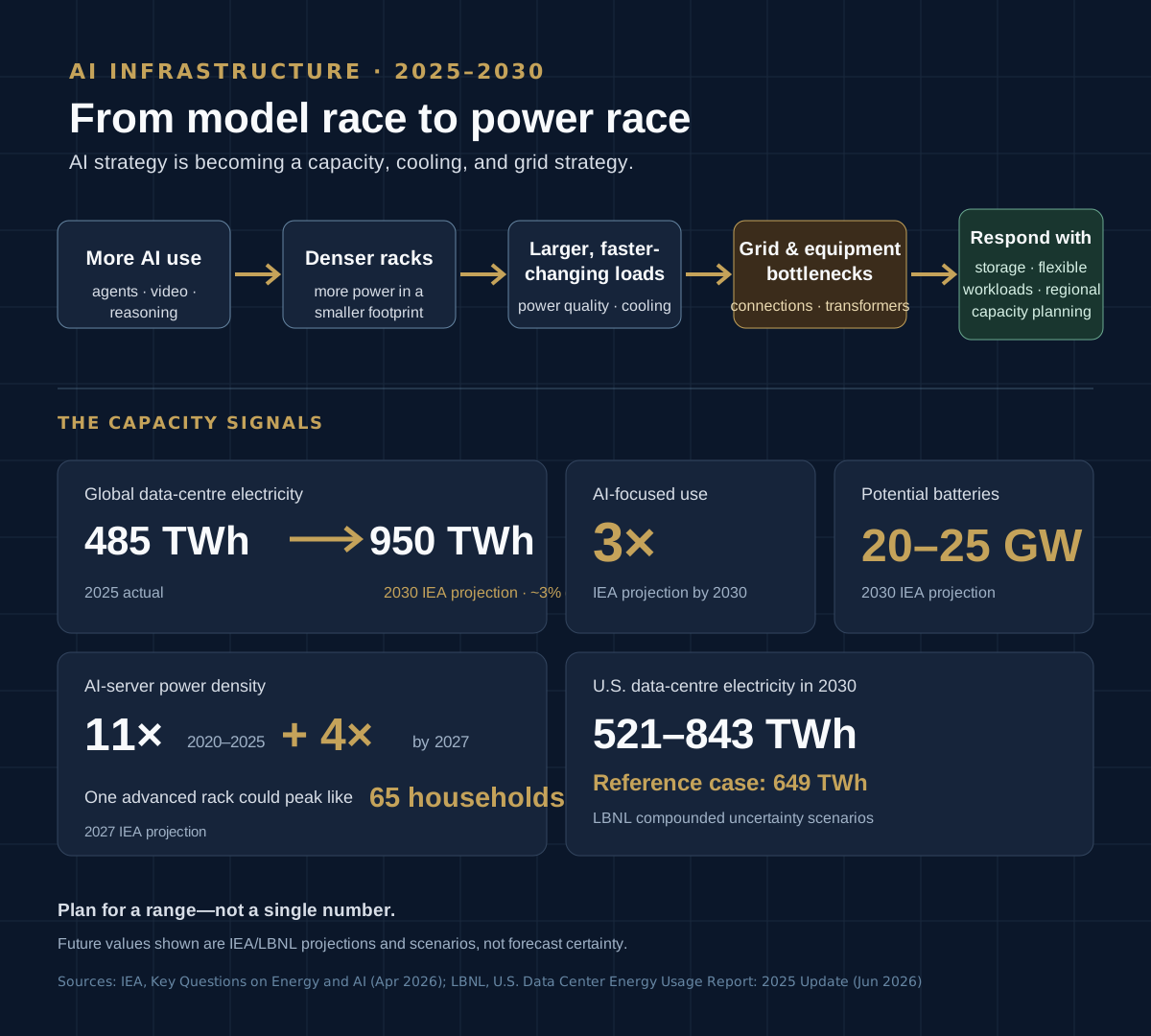
From model race to power race. All future values are IEA or LBNL projections and scenarios, not observed outcomes. Sources are linked below.
Power density matters as much as total consumption
Annual energy is only part of the engineering problem. AI servers concentrate much more power into each rack and can create large, rapid swings in demand. According to the IEA, AI-server power density rose elevenfold between 2020 and 2025 and is projected to rise another fourfold by 2027. At that point, one advanced rack could have peak demand comparable to 65 households.
That density changes the facility design. Delivering more electricity through a smaller footprint places greater demands on power electronics, transformers, cabling, and cooling. Rapidly changing loads also make power quality and energy storage more important. A conventional availability statement—“the region has enough megawatts”— does not answer whether the site can reliably support dense, variable AI workloads.
This is why a GPU reservation is not the same as usable AI capacity. Capacity is the whole chain: accelerator, memory, network, electrical equipment, cooling, and a reliable source of power. The weakest link sets the deployment ceiling.
Efficiency alone will not solve it
Per-task efficiency is improving quickly. The IEA reports that energy use per AI task has fallen by at least an order of magnitude annually in recent years. That is real progress, but it does not translate automatically into lower total demand.
Three forces move together: efficiency, adoption, and workload intensity. Cheaper inference expands the number of viable use cases. Reasoning, video, and agentic tasks can use hundreds or thousands of times more energy per query than simple text generation. Agents also turn one user request into many model calls, tool invocations, and verification steps. Efficiency lowers the cost of each unit while product design creates more units.
Leaders should therefore measure both sides of the equation: useful work per unit of compute and the total workload portfolio. “Our new model is more efficient” is incomplete without “and here is how traffic, context length, reasoning depth, and agent loops are changing.”
The architectural consequences
The immediate response is not to stop building. It is to make infrastructure constraints explicit in architecture and vendor management.
Treat region availability as a dependency
Ask which regions have firm capacity, which are constrained, and what expansion commitments actually mean. Map latency, data residency, and recovery requirements against power and accelerator availability. A preferred region without credible capacity is not a complete architecture.
Make workloads movable in time and place
Not every job needs to run immediately or in the same region. Batch evaluation, fine-tuning, synthetic-data generation, and some agent workflows can be queued, paused, or shifted. Separating latency-sensitive inference from flexible compute creates options during regional constraints and can improve utilization.
Match model capability to the task
Reserve premium accelerators and frontier models for work that demonstrates a quality advantage. Routing, classification, extraction, and routine generation often belong on smaller models. The goal is not the smallest model everywhere; it is the least constrained infrastructure that meets the product requirement.
Design portability before capacity is scarce
Portable evaluation suites, model gateways, versioned prompts, and clear fallback behaviour reduce the cost of moving between models, hardware classes, or providers. Portability does not mean pretending all models are interchangeable. It means knowing where they differ and having evidence for the trade.
Put energy assumptions into vendor diligence
Capacity guarantees, burst policies, regional roadmaps, cooling constraints, and expansion costs belong beside price, security, and availability in enterprise reviews. If the provider cannot explain what happens when a region is constrained, the risk has not disappeared—it has merely been transferred to your application.
A better AI-readiness checklist
Add five questions to the next infrastructure review:
- Where will capacity come from? Identify the regions, providers, accelerator classes, and contractual commitments behind the growth plan.
- What happens during regional constraints? Define quotas, degradation paths, failover behaviour, and which workloads receive priority.
- Can workloads shift in time or location? Classify work by latency, residency, scheduling flexibility, and tolerance for interruption.
- Which models genuinely require premium accelerators? Use task-level evaluations to justify capability instead of selecting by reputation.
- Who bears power, cooling, and expansion costs? Make pass-through pricing, reserved-capacity terms, and stranded commitments visible to finance and product.
The U.S. range illustrates why scenario planning matters. Lawrence Berkeley National Laboratory’s reference case estimates 649 TWh of U.S. data-centre electricity use in 2030, with compounded uncertainty scenarios spanning 521–843 TWh—about 9.5%–15.3% of U.S. electricity use. Those are modeled scenarios, not observed results or a single forecast. Architecture should be robust across a band, not optimized for one point.
Optimize intelligence per unit of constrained infrastructure
The next phase of AI will still reward better models. It will also reward organizations that can place work intelligently, choose the right capability for each task, negotiate credible capacity, and adapt when a region or supplier is constrained.
The useful metric is no longer model performance in isolation. It is business value—or intelligence delivered—per unit of constrained infrastructure. Teams that adopt that lens will make better cloud commitments, build more portable platforms, and avoid discovering too late that their AI roadmap depends on a transformer, cooling system, or grid connection that does not yet exist.